
You booked the Kangarootime demo because the person on the phone said it would finally pull your billing, attendance, and enrollment into one place. The demo was good. Then you asked what it costs, and the rep said they would “put together a custom quote” and asked how many locations you run. You run one. Maybe two. You hung up with no number and the feeling a lot of directors get: this was built for a company with a regional manager, not for me and the phone that rings while I am covering the two-year-old room.
If that is you, this post is the shortcut. I spent eleven years as a director, and I have watched good operators overpay for enterprise software they use a third of. The short answer first. Kangarootime is a capable childcare management platform, but it is quote-only, priced and built for larger groups, and it will not hand you a number without a demo. If you run one or two centers, you have cheaper, more transparent options that do the same daily jobs, plus a separate way to fix the thing that actually fills seats: fast follow-up with the families who inquire. This covers what Kangarootime costs, five alternatives worth knowing, and which one fits a home daycare, a single center, and a small group.
What this post covers
- What Kangarootime actually is
- What Kangarootime really costs in 2026
- The five alternatives worth knowing
- How they compare on the eight things that matter
- Steal this: the follow-up messages that do the work
- Which one fits you: solo, single center, small group
- The compliance part you cannot skip
- Your likely objections, answered
- Your questions, answered
What Kangarootime actually is
Be clear on what you are replacing. Kangarootime is a childcare management platform. It runs the inside of a center: attendance and check-in, classroom ratios, daily reports and photos to parents, billing and payments, and family records, with enrollment and lead features on top. On paper it does nearly everything, which is why it gets pitched to centers that want to stop juggling four separate tools.
The catch is that “does everything” and “right-sized for you” are not the same thing. Kangarootime is built for the mid-market and above, the same tier as LineLeader by ChildcareCRM, which means a lot of its value sits in features a single center never switches on: multi-site reporting, central administration, enterprise billing rules. For a 150-child group with an office manager and a bookkeeper, that can be a fair trade. For a home daycare or one center, it is a big tool for a small job. It also leans management-first, so the job that actually grows a center, catching inquiries before a competitor does, is often better handled by a cheaper, dedicated layer.
What Kangarootime really costs in 2026
Kangarootime does not publish standard pricing. Every major directory, from Capterra to GetApp, sends you to request a demo, and G2 lists the payment model plainly as “Quote Based.” There is no sticker you can budget against before you talk to sales.
The scattered third-party figures do not agree. SoftwareAdvice lists a starting price around $100 per month with a free trial. Other listings quote per-classroom or per-child figures that contradict each other, and none is the vendor’s own number. When the public data is this noisy, the only reliable figure is the one in your written quote. G2 reviewers also report a typical implementation of roughly two months.
So the honest picture: Kangarootime is quote-only software, priced around your location count and the modules you pick, with a multi-week onboarding. It is just a poor fit if you run one or two sites and need your follow-up fixed this month. Ask any rep one thing first: what does this cost per month, all in, for a single center at my enrollment, and how long until I am live? “Let’s build a custom quote” and “about two months” means it is built for someone with a procurement process, not for you.
The five alternatives worth knowing
The market mixes two jobs people treat as one. Management tools run the inside of your center; enrollment tools run the outside. Kangarootime is management-first, and most of its “alternatives” are too, with one that publishes its price and one built specifically for follow-up. Here are the five worth your time.
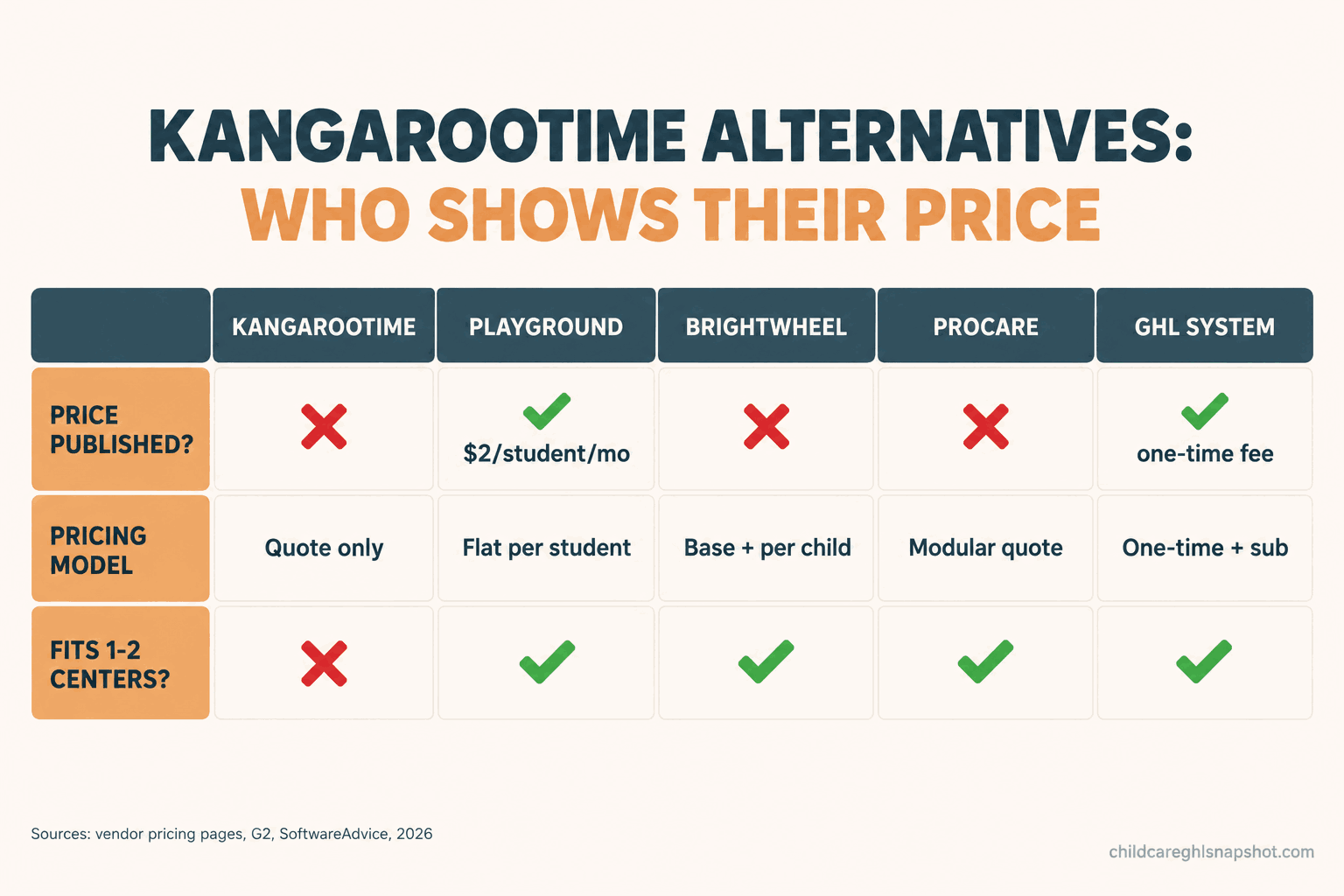
Playground is the transparency benchmark for the whole category. It publishes a flat $2.00 per student per month, with no contract and no setup fee, stated plainly and echoed on listings like SaaSworthy and SoftwareAdvice. It is management-first, so enrollment is a feature rather than the main event, but you see the price before you talk to anyone, which almost nobody else in childcare allows. At a 60-child center that is about $120 a month, math you can do in ten seconds.
Brightwheel is where most directors already are: the default all-in-one with check-in, daily reports, billing, and a lead-management side. Pricing is demo-gated, and operators report a base fee plus a per-child charge, often a few dollars per child monthly, so the bill climbs as you enroll. Payment processing sits on top, reported around 2.9% plus $0.30 per card transaction. A solid management product first.
Procare is the old guard, sold in modules and quote-only. Third-party listings put a licensed center around $60 to $85 a month before add-ons, with implementation running from roughly $1,000 to $5,000 for bigger setups. Deep billing, but heavier to learn.
Lillio (formerly HiMama) is the parent-communication specialist, strong on daily reports, photos, and developmental tracking. It is one of the few that gives real numbers, commonly reported at roughly $8 to $12 per child per month, and lighter on enrollment follow-up.
A done-for-you GoHighLevel enrollment system is built around the one job the management tools treat as a side feature: follow-up. It is priced as a flat one-time setup instead of a per-location subscription. That is the category our own Childcare & Daycare Snapshot sits in: missed-call text-back, tour booking and reminders, waitlist nurture, and review requests, installed for a one-time fee with no per-child charge. It runs alongside whatever management app you keep.
How they compare on the eight things that matter
A grid only helps if the rows map to money. Here are the eight that decide whether a tool fills seats.
| What matters | Kangarootime | Playground | Brightwheel | Procare | GoHighLevel system |
|---|---|---|---|---|---|
| Built mainly for | Management (mid-market) | Management | Management | Management | Enrollment / follow-up |
| Price published? | No, demo-gated | Yes, $2/student/mo | No, demo-gated | No, demo-gated | Yes, one-time fee |
| Pricing model | Quote, per location/tier | Flat per student | Base + per child | Modular | One-time + GHL sub |
| Built for 1-2 centers? | Not really | Yes | Yes | Yes | Yes |
| Speed-to-lead text-back | Partial | Partial | Partial | Partial | Yes |
| Waitlist nurture | Basic | Basic | Basic | Add-on | Yes |
| Time to go live | ~2 months | Days | Days | Weeks | ~24 hours |
| Runs attendance too | Yes | Yes | Yes | Yes | No, pairs with one |
Now the rows that actually decide it, because the grid hides where things break.
The pricing model, which matters more than the number. A quote priced per location and tier (Kangarootime, Procare) is whatever the sales process lands on, and it climbs when you open a second site. A per-child rate (Brightwheel, Lillio) grows every time you fill a seat, so a “$160 a month” tool quietly becomes $240 after a strong season, and nobody re-checks the invoice until budget time. A flat rate is the only one you can actually plan around.
Speed-to-lead, which none of the management tools truly own. The most valuable feature is a missed-call text-back and an instant reply to web inquiries, because families shopping childcare contact more than one center and go with whoever calls back first. When your “lead capture” is a form that just emails you, that email lands while you are in a classroom and the family books a tour down the road. A follow-up layer does it in under a minute, from a number the parent can text back.
Tour reminders and waitlist nurture. Booking is easy; reminders win tours and a real waitlist nurture keeps families warm for months. You want an automatic confirmation, a day-before reminder, and a morning-of text, all hands-off. It breaks when the reminder sends from a no-reply number, so “can we move to Thursday?” vanishes and the tour dies, or when a spot opens, you finally call the top name, and they enrolled somewhere else back in the spring. Management tools mostly store the list and leave the nurturing to you. Kangarootime’s roughly two-month onboarding is a real commitment on top of all this, painful for a director who needed it last week, where a done-for-you install takes about 24 hours because the workflows are pre-built.
Steal this: the follow-up messages that do the work
Whatever tool you land on, the automation is only as good as the words it sends, and the expensive platforms do not have better copy than this. Here is a sequence you can lift today. Keep it short, keep it warm, and make every message easy to reply to from a phone.
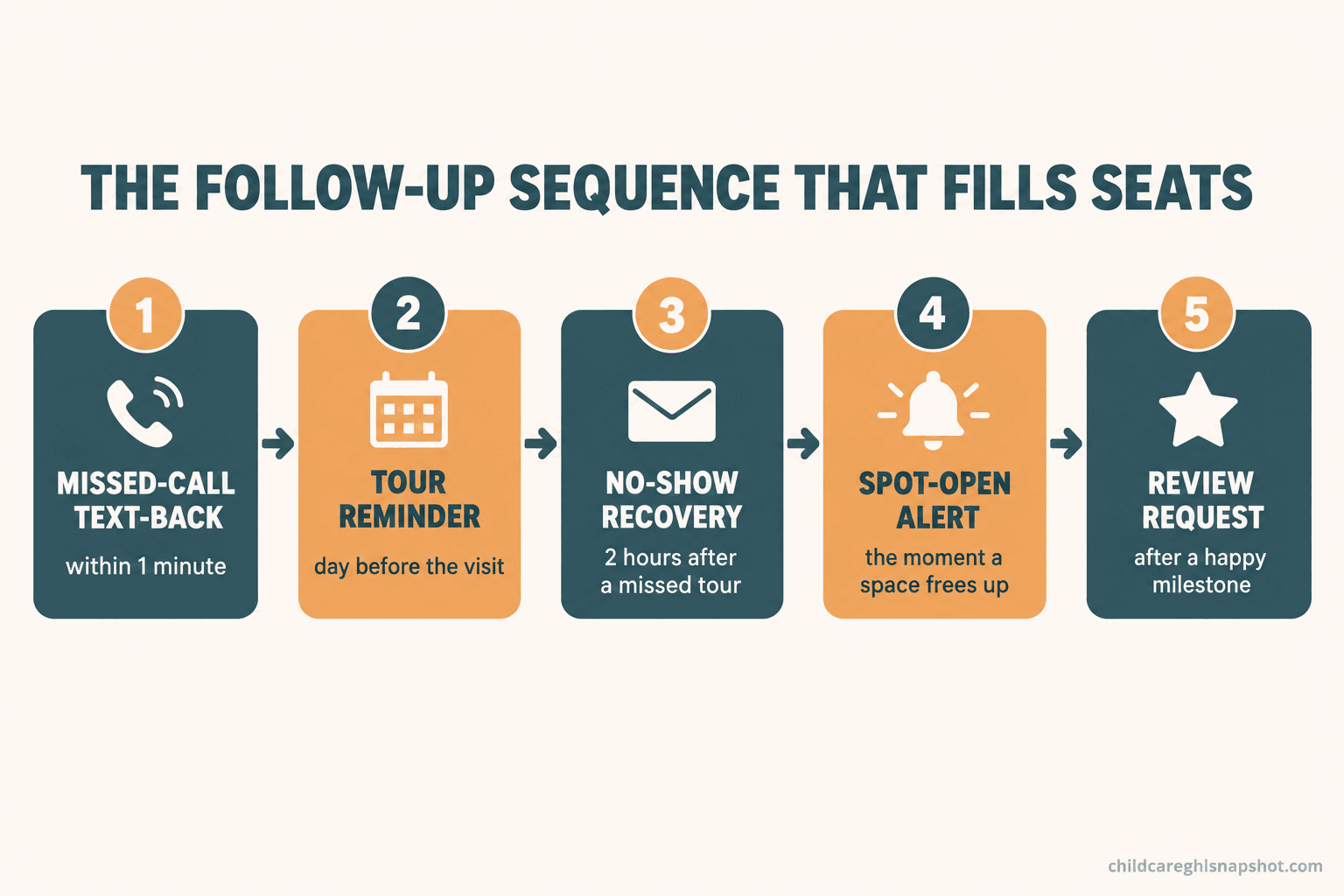
Missed-call text-back (within one minute of a missed call):
Hi, this is [Center Name]. So sorry we missed you. Were you calling about a spot for your little one? I can check availability and get you booked for a quick look around. What is their age?
Tour reminder, day before:
Looking forward to seeing you tomorrow at [time], [First Name]. We are at [address], and parking is [note]. If anything comes up, just reply here and we will find another time.
No-show recovery (two hours after a missed tour, never scolding):
Hi [First Name], we had you down for a visit today and did not want you to think we forgot about you. Mornings with little ones are unpredictable, we get it. Want me to hold a new time this week?
Spot-open alert (the moment a space frees up):
Good news [First Name], a spot just opened in [room] for [age group]. Because you are on our waitlist, I can hold it for 48 hours. Reply YES and I will send the paperwork over.
Review request (to a happy family after a good milestone):
Hi [First Name], it has been a joy having [child] with us. If you have 30 seconds, a quick Google review helps other local families find us: [link]. Thank you for trusting us.
That is the whole follow-up spine of a center, and none of it needs a quote-only platform with a two-month rollout. It needs a tool that fires these on a trigger and routes every reply to a real person.
Which one fits you: solo, single center, small group
The solo operator (home daycare, about 12 children). You do not need an enterprise platform, and Kangarootime would be absurd here. You need to stop losing an inquiry while your hands are in finger paint. A flat, cheap management tool like Playground at $2 per student (about $24 a month) plus a light missed-call text-back on your business line covers it.
The single center (about 60 children). This is where follow-up moves the money, and where Kangarootime tempts you and then prices you out. You have enough inquiry volume that answering by hand leaks enrollments, but not enough to justify a per-location quote and a two-month rollout. This is the sweet spot for a flat-fee enrollment layer over a transparent management app: keep Playground or Brightwheel for attendance and billing, and add a GoHighLevel setup for speed-to-lead, tours, and waitlist.
Estimated year-one software spend at a 60-child center. Playground uses its published $2.00/student/month flat rate ($1,440). The GoHighLevel system shows the one-time $997 setup (a GoHighLevel subscription is separate). Brightwheel uses the per-child rate operators report on third-party sites (around $3/child), not a vendor quote, and excludes payment-processing fees. Sources: SaaSworthy, Neztio. Kangarootime is omitted; it publishes no comparable figure.
The small group (two or three sites, about 150 children). Now Kangarootime is at least a fair conversation, because quote pricing and central multi-site administration start to make sense with several locations and someone whose job is operations. Even so, get the all-in monthly number and the onboarding timeline in writing, and compare it against one flat-fee enrollment layer running across all your sites. The question is whether you are paying enterprise prices for central-admin features you will not staff.
The compliance part you cannot skip
Before you automate a single text, clear up the rules, because getting this wrong is expensive. Drop one myth first: FERPA, the school-records law, generally does not apply to private licensed daycares, so do not let a vendor wave it around to sell you something. Your real obligations come from your state’s licensing rules on child-record confidentiality and on photo and video consent, which most states require in the licensing packet and which you cannot make a condition of enrolling a child. The line to hold: never name or show a specific child in marketing without consent on file, and keep any automation that touches attendance or health data in the parent-only channel, never feeding your marketing list.
Texting families is also governed by the TCPA and A2P 10DLC, the carrier rules for business texting. In plain terms: you need real consent to text a prospective family, every message needs a clear opt-out (reply STOP), and your sending number should be registered so texts deliver instead of getting filtered as spam. Good enrollment tools handle that plumbing. The full version is in the 2026 guide to texting daycare parents legally.
Your likely objections, answered
“I already pay for Brightwheel. Do I have to switch?” No, and you probably should not. Brightwheel is a fine management app; the gap it leaves is fast follow-up and real waitlist nurture. Keep it for the inside of your center and add a follow-up layer on top.
“Isn’t Kangarootime better because it is enterprise software?” Price and polish are not the same as fit. Kangarootime is well-built for its target, a mid-market or multi-site group with operations staff. For one or two centers, a lot of its strength sits in features you will never switch on. Match the tool to your size, not to the sticker you never saw.
“Isn’t GoHighLevel just another CRM I do not want to learn?” Under the hood, yes. The difference with a done-for-you setup is that you do not build it or learn it. The workflows arrive pre-built, so day to day you touch a simple list of families and the odd reply to a parent text. You buy the result, not a software project.
“Will families find the automated texts annoying?” They find slow, robotic, no-reply texts annoying. A warm message sent fast, from a number they can text straight back, reads as a center on the ball. Automate the sending, not the caring.
Your questions, answered
What is the best Kangarootime alternative for a small childcare center?
For one or two centers, the strongest alternatives are Playground (flat $2 per student per month, fully transparent) and a done-for-you GoHighLevel enrollment system (one-time setup fee, built for speed-to-lead, tours, and waitlist nurture). Brightwheel and Procare are fine management apps if you prefer the all-in-one route, though both gate pricing behind a demo. Kangarootime itself suits mid-market centers and multi-site groups.
How much does Kangarootime cost in 2026?
Kangarootime does not publish standard pricing and gives you a custom quote on a demo, priced around your location count and feature tier. SoftwareAdvice lists a starting figure around $100 per month with a free trial, but third-party numbers conflict, so treat the written quote as the only reliable figure. G2 reviewers report a typical implementation of about two months.
Does Kangarootime publish its pricing?
No. Every major directory routes you to a demo, and G2 lists its payment model as quote based. There is no public price list you can budget against before talking to sales, which is the main reason small centers look for an alternative that shows a number.
Is Kangarootime a management app or an enrollment tool?
Primarily a management platform. It runs attendance, ratios, daily reports, billing, and family records, with enrollment features added on. If your real problem is answering inquiries fast and nurturing a waitlist, a dedicated follow-up layer often fixes that more cheaply.
Which childcare software shows its price upfront?
Almost none in the category. Playground is the standout, with a flat $2.00 per student per month stated openly and no contract. Lillio publishes rough per-child figures too. A flat-fee GoHighLevel setup gives you a known one-time number. Kangarootime, Brightwheel, and Procare all gate pricing behind a demo.
What does the Childcare Snapshot cost, and does it replace Kangarootime?
It is a one-time $997 setup on top of a GoHighLevel subscription, with no per-child or per-location fee. It handles the enrollment job (speed-to-lead, tours, waitlist nurture, reviews) at a flat price, built for one or two centers rather than chains. It is not a management app, so it runs alongside your attendance and billing tool rather than replacing it.
So, back to that demo that quietly felt three sizes too big. The pull was real; you do want attendance, billing, and follow-up to stop living on sticky notes. You were just handed a tool built for a company with an operations director. Keep a management app that shows its price, add a flat-fee follow-up layer sized for your center, and you get the outcome Kangarootime sells without the quote-only contract or the two-month wait. The sector runs on thin margins, and every enrolled family counts, which is exactly why the software that chases them should fit your size, not someone else’s.