
It is a Thursday morning and a dad is buckling his daughter into the car at drop-off. You wave, he waves, everything looks normal. What you cannot see is that last night he and his wife toured the center two streets over and liked it. He is not angry, and nothing went wrong he could point to. He just feels a little less sure than he did a year ago, and nobody at your center has given him a reason to feel sure again. In three weeks he will email his notice, and you will be blindsided.
Here is the short version. The families who leave your daycare almost never complain first. They go quiet: shorter replies, no-shows at family night, tuition arriving late, then a notice email for a spot you did not know was at risk. The fix is not working harder at pickup. It is a simple retention system that spots a family drifting weeks before they decide, and reaches out in a way that feels like care rather than a sales pitch. This post is that system, stage by stage, with the messages you can copy.
What this post covers
- The quiet leak: what one lost family really costs you
- The retention system, stage by stage
- Steal these: the family check-in messages
- Run it three ways: solo, mid-size, and a small chain
- The compliance part you cannot skip
- Objections I hear from directors
- Your questions, answered
The quiet leak: what one lost family really costs you
Think about where your attention goes. You spend your energy on tours and inquiries, because an empty seat is loud and obvious. A family slowly deciding to leave is silent: still paying, still dropping off. So you do not worry about them until they are gone.
That silence is expensive. At the 2025 national average of $13,184 a year, reported by Child Care Aware of America, a single child kept enrolled for three years is worth $39,552 to your center. Lose six of those families in a year you could have kept, and you have quietly handed roughly $79,000 of annual tuition to the center down the road. In higher-cost markets, where infant care runs up to $27,067 a year in the same report, one lost family is a five-figure hole.
And families leaving is not rare. In LineLeader’s 2025 early childhood benchmark, 42% of childcare professionals said only half or fewer of their families re-enroll after the first year. That is an industry survey, not hard research, but it matches what directors see: the first year is where you lose people, quietly.
What enrollment is worth at the 2025 national average of $13,184 from Child Care Aware of America. The three-year and six-family figures are simple multiples of that average.
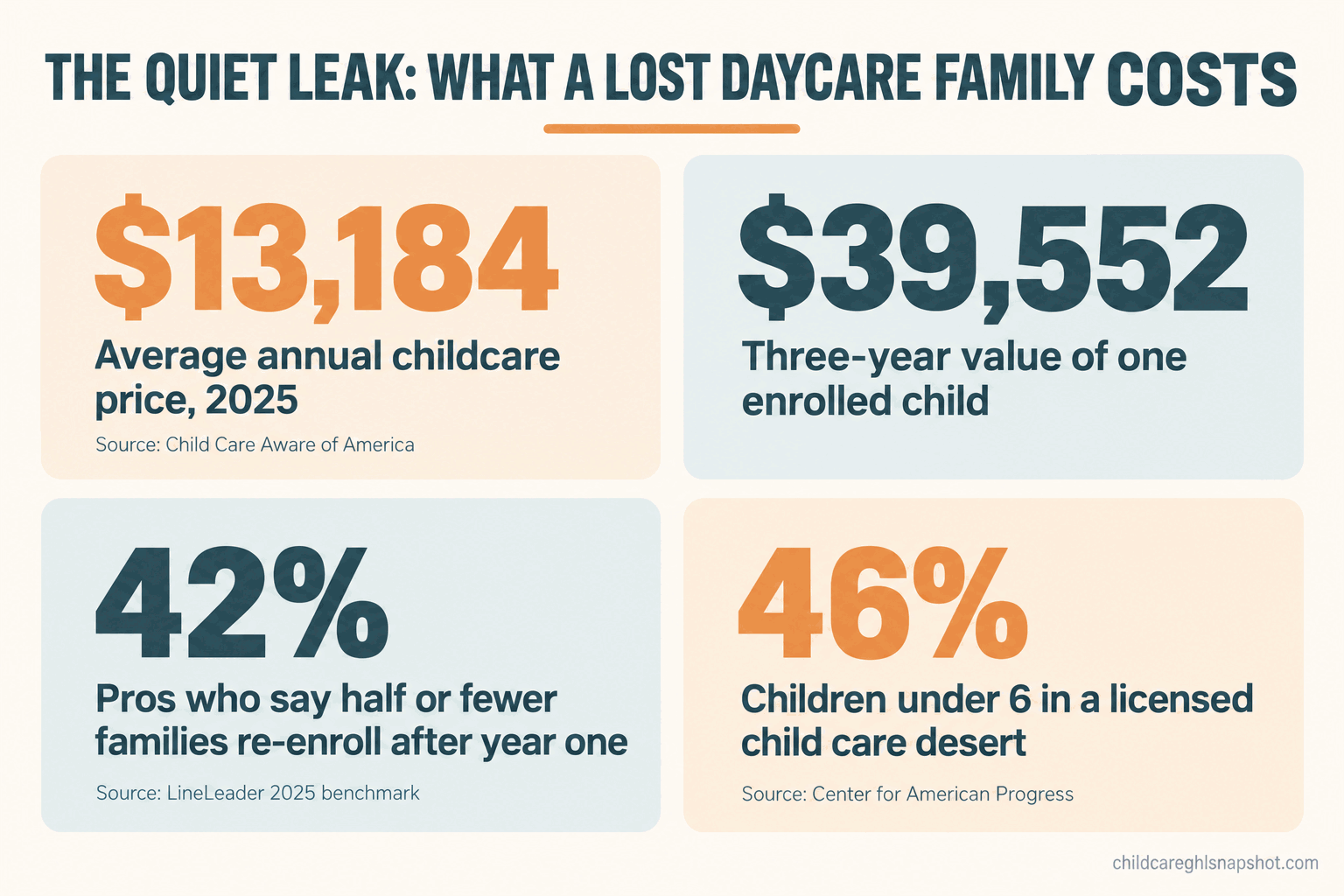
And you do not just lose their tuition. In a market where 46% of children under 6 still live in a licensed child care desert, per the Center for American Progress, that family will find care somewhere, so your empty seat becomes a competitor’s full one, with the reviews and referrals that follow.
The retention system, stage by stage
The goal is not to chase every parent or smother families with messages. It is to notice drift early and respond with warm, timed contact so a wobbling family feels seen before they go shopping. Six stages do that, and most of the noticing runs quietly in the background.
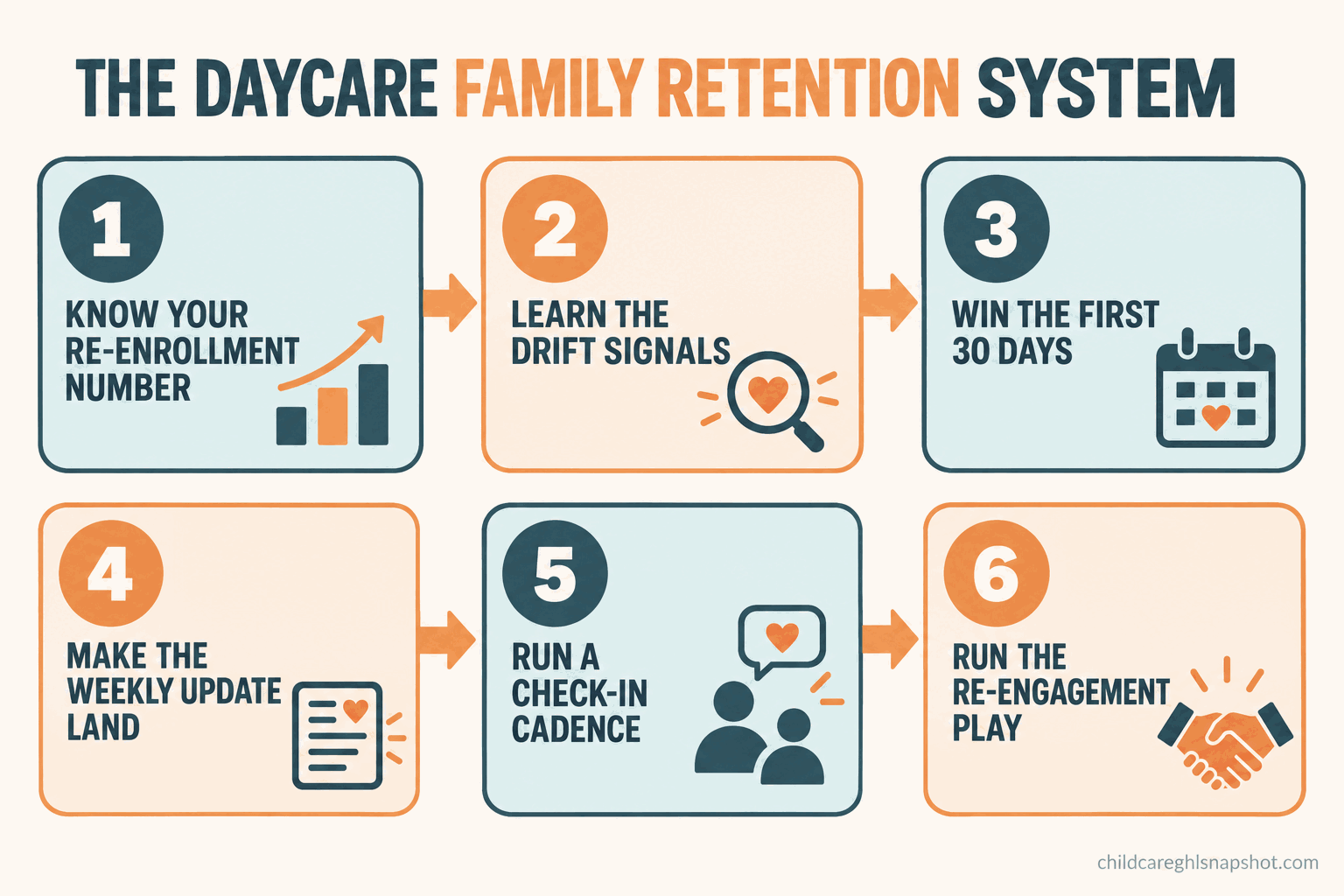
Stage 1: Know your real re-enrollment number
You cannot fix a leak you cannot measure. Most directors can tell you their enrollment to the child, but not what share of families made it past their first year. So put a number on it: count the families you had twelve months ago, then how many are still here. That percentage is your retention rate, the most honest number about the health of your center.
How this breaks: The usual failure is confusing enrollment with retention. A center can be full and still churning badly, because new families keep backfilling the ones quietly leaving, so you feel fine until a slow month exposes the leak. Track the families, not the headcount.
Stage 2: Learn the drift signals
Families almost never announce that they are unhappy. In a federal study of how parents search for and select child care, dissatisfaction with a current provider was a real driver of parents going out to look for a new one, even though most never filed a complaint first. So you watch behavior, not words. The signals are small alone and loud together: warm replies go to one word, tuition starts landing late, the parent skips the family event, the daily report goes unopened, the questions stop. Any one is nothing. All of them together is a family with one foot out the door.
How this breaks: The failure is waiting for the signal to be obvious. By the time a parent says “we’re thinking about our options,” they have usually already toured elsewhere. The signals also only work in one view, not scattered across billing, messages and a clipboard.
Stage 3: Win the first 30 days
Retention is mostly decided early. A family that feels lost or unseen in their first month is already quietly comparing you to the place they almost chose. A warm, structured first 30 days, a welcome message, a photo from day one, a check-in after the first week, is the cheapest retention you will ever buy. The new-family onboarding playbook covers this in detail.
How this breaks: The classic mistake is treating onboarding as paperwork. You collect the forms and the deposit and then go quiet, right when the family is most anxious, and silence in week one reads as “they already forgot about us.” A short sequence of warm, scheduled touches in the first month prevents that.
Stage 4: Make the weekly update actually land
The ordinary daily or weekly update is your most reliable retention tool, the one moment a parent feels connected to a day they did not see. A photo of their toddler painting, a one-line note about a nap or a new word, lands as proof that their child is known, and the parent re-chooses you a little every day. For the version that families actually read, see daily reports parents love.
How this breaks: A generic, copy-pasted update that could be about any child tells a parent you are going through the motions, and inconsistency (great one week, silence the next) is just as corrosive. Pick a cadence you can sustain and keep each update specific.
Stage 5: Run a real check-in cadence
Most centers only talk to a family on purpose when something is wrong. A retention system flips that: you reach out on a schedule, before there is a problem. A quick check-in around 30 days, a “how’s it going” at 60, a real conversation at 90, then a light touch each quarter. The reminders are automated; the message comes from a person who knows the child.
How this breaks: The failure is making the check-in feel like a survey, because a parent can smell “how are we doing, please rate us” from a mile away. Keep it human, specific to the child, and two-way. The other failure is only checking in with the families you already like talking to, and missing the quiet ones.
Stage 6: Run the re-engagement play when a family goes quiet
When the drift signals do fire, you need a move that is not awkward and not pushy: a warm reach-out that names something real about the child and opens a door, a call, a coffee with the director. The point is to surface whatever is bothering them while it is still fixable. A frustration you hear about is one you can solve; a frustration you never hear about walks out the door. The same instinct powers winning back cold daycare inquiries.
How this breaks: The worst version is going quiet right back, which is how a save becomes a loss. The other is reaching out in a way that is all about you (“we noticed you’ve been less active”) rather than about the child. Lead with the child, always.
Steal these: the family check-in messages
Here is the actual copy for the check-in cadence and the re-engagement play. Change the names, keep the warmth and the specifics. Use your director’s real first name, because a parent trusts “Ms. Priya” over “the team,” and always name the child.
Two rules carry this copy: every check-in names the child and something specific about their week so it never reads like a template, and every message asks a real question that is easy to answer honestly. The point is to hear the small frustration while you can still fix it.
Run it three ways: solo, mid-size, and a small chain
The same six stages scale, but what you automate and what you do by hand shifts with size.
How a retention system changes with the size of your center
| Plan | Solo (30-50 kids) | Mid-size (60-100 kids) | Small chain (2-3 sites) |
|---|---|---|---|
| Price | Start with 3 stages | Full six stages | Six stages + per-site |
| Feature 1 | Monthly re-enrollment count | Signals from billing, messages, attendance in one view | Re-enrollment tracked per location |
| Feature 2 | Watch late tuition + unopened reports | Automated 30-60-90 reminders | Drift alerts routed to the right director |
| Feature 3 | Director sends check-ins by hand | One person owns the quiet-family list | At-risk dashboard across sites |
| Feature 4 | Risk: you get busy, check-ins stop | Risk: check-ins feel like a survey | Risk: head office nags instead of caring |
If you are solo, do not run all six stages at once. Count your re-enrollment number, watch the two loudest signals (late tuition and unread reports), and put the 30-day and 90-day check-ins on your own calendar. That alone catches most of the families you are losing without noticing.
If you are mid-size, the full system earns its keep: too many families for one person to hold in their head, so the drift signals surface automatically and the reminders fire on their own, with one person owning the “quiet families” list each week.
If you run two or three sites, it becomes an engine with per-site tracking, and the trap is running retention from a head-office spreadsheet. The alert has to reach the director at the site who can pick up the phone and mean it.
The compliance part you cannot skip
Retention messaging touches the same nerves any parent texting does, so handle it the same careful way. Get this right and it protects you.
Texting families is still texting, so the TCPA rules apply. Under the TCPA, marketing texts are generally restricted to 8am to 9pm in the recipient’s local time, and you need consent. A service check-in to an enrolled parent sits on safer footing than a cold blast, but still keep it in daytime hours, include an opt-out, and honor every “stop,” as the FCC requires. For the full rundown, see how to text daycare parents legally.
Register for A2P 10DLC before you send any volume. US carriers filter business texts from ordinary ten-digit numbers unless the business and its campaign are registered through the A2P 10DLC system. Skip it and your warm check-ins quietly fail to deliver.
Keep enrolled-child data in the parent-only channel. State licensing rules, not FERPA, govern child-record confidentiality and photo consent for a private licensed daycare, and most states require consent in the licensing packet without letting you make it a condition of enrollment. So a retention message can reference a child warmly to that child’s own parent, but a child’s name, photo, attendance or health data must never cross into your marketing list or a public post.
Objections I hear from directors
“Isn’t this just more work I don’t have time for?” The opposite, once it is set up. Chasing a family after they have given notice is the expensive, time-eating work, and it usually fails. A quiet system that flags a drifting family and reminds you to call takes minutes a week.
“I already pay for Brightwheel or Procare. Doesn’t that handle retention?” Those tools send the daily report and run billing, which is part of stage four. But they do not track your re-enrollment rate, flag a drifting family, or run a 30-60-90 check-in cadence. This runs beside your parent app, not instead of it. For the honest cost picture, see what childcare software actually costs in 2026.
“Won’t families feel managed or tracked?” The opposite, done right. A parent never sees the signals or the dashboard. What they experience is a director who reaches out on a good day to say their child is thriving, and who asks before a small frustration becomes a reason to leave. That reads as care.
“What if a family is leaving for a reason I can’t fix, like a move?” Some families leave no matter what, and that is fine. The system is about catching the ones leaving over something fixable, a scheduling issue, a feeling of being unseen, a question nobody answered, which is a bigger share than most expect. Even the ones who move send referrals if the goodbye was warm, which is why reviews and referrals start with how you treat families on the way out.
Your questions, answered
Why do families leave a daycare without complaining first?
Because complaining feels confrontational, and most parents would rather quietly find another option than have a hard conversation with the people caring for their child. Dissatisfaction shows up as behavior long before it shows up as words: shorter replies, late tuition, skipped events, unopened updates. By the time a parent tells you they are unhappy, they have often already toured somewhere else, which is why a retention system watches behavior rather than waiting for a complaint.
What is a good re-enrollment or retention rate for a childcare center?
There is no single official benchmark, and it varies by market and age group. What matters more than a magic number is knowing your own rate and watching it over time. In LineLeader's 2025 industry benchmark, 42% of professionals said only half or fewer of their families re-enroll after the first year, so keeping well more than half of your first-year families puts you ahead of a large share of the field.
What are the warning signs that a family is about to leave?
Watch for a cluster of small changes rather than any one thing: replies that get shorter or stop, tuition that starts arriving late, a parent who skips events they used to attend, daily reports that go unopened, and questions that dry up. On their own each is minor. Together they are a reliable signal that a family is drifting, usually weeks before they give notice, the window where a warm, specific check-in can still change the outcome.
How often should I check in with current daycare families?
A practical cadence is a check-in around 30 days, a light touch at 60, a real conversation at 90, then a short quarterly touch, plus an extra reach-out any time the drift signals fire. The key is that these are warm, specific, two-way messages that name the child and invite an honest answer, not surveys. Automate the reminder; keep the message human.
Is it legal to text current parents retention check-ins?
A genuine service check-in to an enrolled parent stands on safer footing than cold marketing, but still treat it carefully: keep texts inside 8am to 9pm in the parent's local time, get consent, include an opt-out, and honor every stop immediately, consistent with the TCPA and FCC rules. Register for A2P 10DLC so your texts actually deliver, and keep anything about a specific child in your parent-only channel, never your marketing list. This is general information, not legal advice.
So picture that Thursday drop-off again, but this time your system has been quietly watching. Two weeks earlier it flagged that the Morales family had gone quiet: two short replies, one late payment, a skipped family night. Instead of waiting for the notice email, your director texted about how much Theo loved the water table and asked, honestly, whether everything was working for them. The dad called back. The new pickup time was a daily headache, something you fixed in an afternoon. Theo is still enrolled next fall. You did not work harder. You just made sure the family who was quietly drifting got a reason to feel sure again, before the center two streets over gave them one.