
It is 7:40am, the lobby is full of coats and lunch boxes, and a woman in a lanyard you do not recognize is standing in the doorway of the infant room with a clipboard. Your licensing inspector. She is counting heads, then counting adults, doing the one piece of arithmetic that can close a room before lunch. Five babies, one teacher. In your state that is a violation, and she writes it down.
Here is the answer up front. There is no national daycare ratio. The number that governs your building is your own state’s licensing ratio, set by age, and it does two jobs. It decides when you may legally keep a child in a room, and it sets the cost of running that room, because it tells you how many adults you must pay before a single parent writes a check. An infant room at one teacher to four and a preschool room at one to eighteen are not just different rules, they are different businesses. This post gives you the real 2026 ratios for the four biggest states, shows you how to read your own state’s rule, and turns the number into a staffing cost, a daily check, and a tour line that makes parents trust you.
What this post covers
- Why there is no national daycare ratio
- The cheat sheet: ratios by state and age
- Texas and New York, read in full
- California and Florida, the quick read
- How to read your own state’s rule
- What the ratio actually costs you
- Run it three ways by center size
- How ratios break you
- Steal this: the ratio board and tour copy
- Objections and FAQs
Why there is no national daycare ratio
Directors are often surprised there is no single federal number. The federal government funds a lot of child care and requires that states set standards, but it leaves the actual ratios to each state. As the federal Child Care Technical Assistance Network explains on ChildCare.gov, ratios and group sizes are set through state licensing, and they exist for one blunt reason: fewer children per adult means a teacher can see every child, respond faster, and keep the room safe.
The one national reference point is Head Start, which runs infants and toddlers under three at one adult to four. Almost no state licence is that strict across the board. The National Institute for Early Education Research found that only 12 states have licensing standards that meet the Head Start 1:4 ratio for one to two year-olds. Playground, one of the few childcare platforms that publishes its pricing openly, puts it plainly in its deep dive on classroom ratios: “Each state sets its own regulations, and the differences can be surprisingly large.” So the ratio that matters is your state’s, at the exact age of the children in the room.
The cheat sheet: ratios by state and age
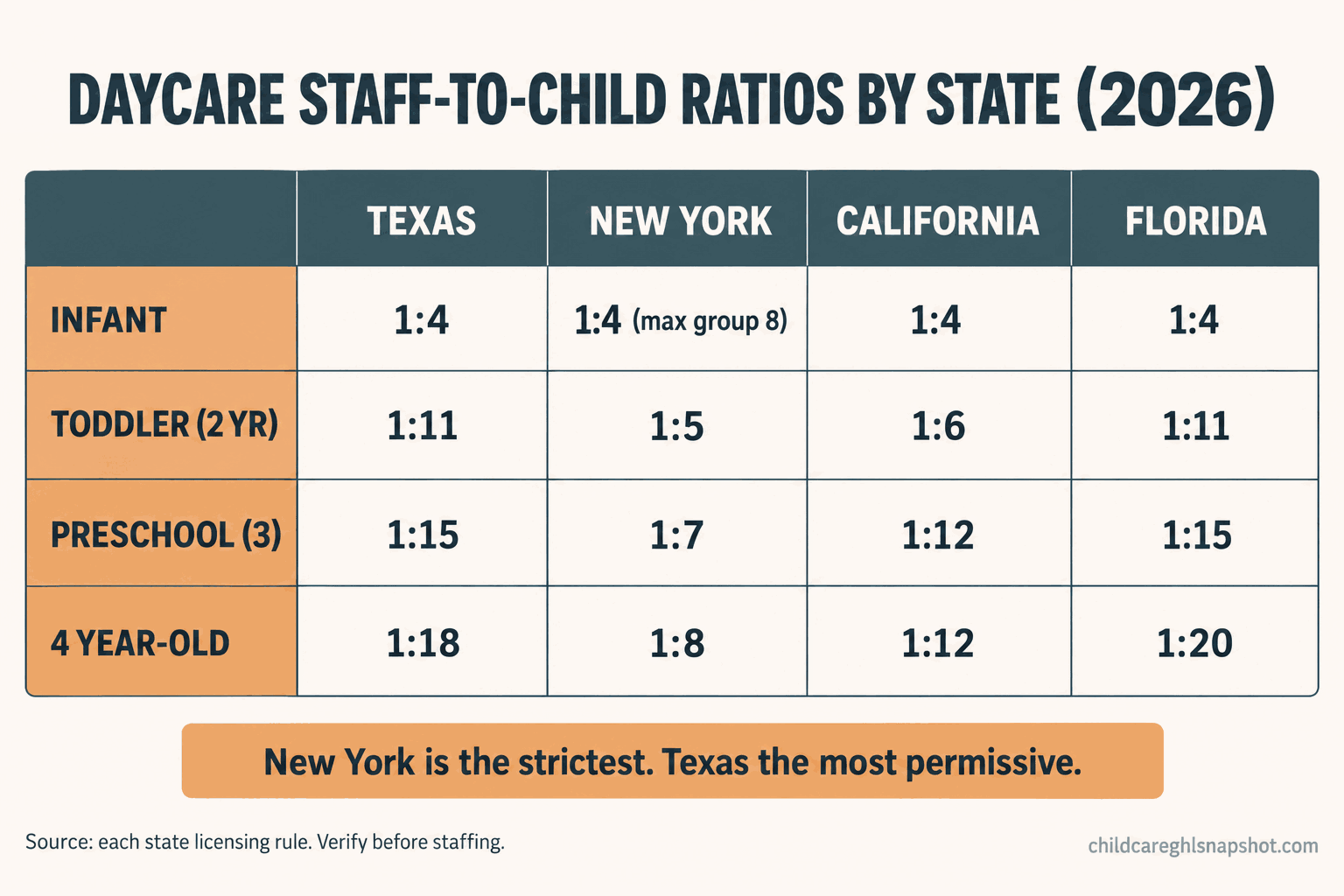
Here are the center-based ratios for the four most populous states. These are licensed center numbers, not family home or state-funded pre-K programs.
| Age | Texas | New York | California | Florida |
|---|---|---|---|---|
| Young infant | 1:4 (0–11 mo) | 1:4 (6 wk–18 mo), group max 8 | 1:4 | 1:4 (under 1 yr) |
| Older infant | 1:5 (12–17 mo) | 1:4 (to 18 mo), group max 8 | 1:4 | 1:6 (1 yr) |
| Toddler | 1:9 (18–23 mo), 1:11 (2 yr) | 1:5 (18–36 mo), group max 12 | 1:6 | 1:11 (2 yr) |
| Preschool (3) | 1:15 | 1:7, group max 18 | 1:12 | 1:15 |
| Preschool (4) | 1:18 | 1:8, group max 21 | 1:12 | 1:20 |
| Five / pre-K | 1:22 | 1:9, group max 24 | 1:12 | 1:25 |
| School-age | 1:26 | 1:10, group max 20 | varies | varies |
Sources: Texas 26 TAC Chapter 746 minimum standards (HHSC); New York 18 NYCRR 418-1.8 (OCFS), via Cornell Legal Information Institute; California Title 22 section 101216.3 (CDSS); Florida Statute 402.305(4). Confirm the current number with your state before staffing.
Every state is tightest on babies and loosens as kids age, which is why infant rooms are hard to run.
Texas and New York, read in full
Texas, under 26 TAC Chapter 746 administered by HHSC, has one of the most detailed age charts in the country, and it loosens fast. For a licensed center: one caregiver to four for zero to eleven months, one to five for twelve to seventeen months, one to nine for eighteen to twenty-three months, one to eleven for two year-olds, one to fifteen for threes, one to eighteen for fours, one to twenty-two for fives, and up to one to twenty-six for school-age. That spread, from 1:4 to 1:26, tells you where the money goes: babies force two or three teachers onto a handful of seats, while one adult covers a crowd of older kids. Texas also allows a looser one to sixteen during the first and last forty-five minutes of the day for children eighteen months and older, but never for the youngest babies, and that window is exactly when a surprise inspection lands. Subsidy seats, under the Texas Child Care Services program, count toward your ratio like any other child.
New York, under 18 NYCRR Part 418-1 administered by OCFS, is among the strictest states, and it catches directors off guard because it controls two numbers. The ratios: one to three under six weeks, one to four from six weeks to eighteen months, one to five for toddlers to thirty-six months, one to seven for threes, one to eight for fours, one to nine for fives, one to ten for school-age. But New York also caps group size by age. An infant group may not exceed eight children, a toddler group twelve. So even with the teachers, you cannot run one infant room of sixteen babies with four adults, because the cap stops you at eight. That changes your floor plan: smaller rooms sized to the cap, each with its own ratio, which means more walls, more lead teachers, and a higher cost structure than Texas.
California and Florida, the quick read
California, under Title 22 section 101216.3 enforced by CDSS, keeps it simple for licensed centers: one to four infants, one to six toddlers, one to twelve preschoolers. Watch the trap: California runs two systems. Title 22 is the track most private centers live under, but state-funded and Head Start programs fall under the stricter Title 5. Do not quote a Title 5 number to a Title 22 inspector or the reverse.
Florida, under Statute 402.305(4), runs the most permissive chart here: one to four under a year, one to six for one year-olds, one to eleven for twos, one to fifteen for threes, one to twenty for fours, one to twenty-five for ages five and up. Florida adds a rule worth memorizing: in a mixed-age room with children two and older, the ratio is set by the age group with the most children. Get the mix wrong and you can be out of ratio while every child is, individually, old enough.
How to read your own state’s rule
If your state is not in the table, pin down three things. First, the exact age bands in months, because states disagree on when a baby becomes a toddler and the ratio only means something attached to the band. Second, whether your state also caps group size on top of the ratio, as New York does. Third, the mixed-age and opening-closing wrinkles, which is where directors fall out of compliance. Confirm it against your state agency’s own site this year, not a vendor summary, and check the revision date.
What the ratio actually costs you, per room
Now the part most ratio guides skip. The ratio is the biggest driver of classroom cost, because it sets the adults you pay before you enroll one child. Payroll is the whole game: the U.S. Treasury puts labor at roughly 60 to 80 percent of a provider’s costs, and the median childcare worker earns about $15.41 an hour per the Bureau of Labor Statistics, nearer forty thousand a year once you load payroll taxes and workers’ comp. Follow one room of eight and the teachers each ratio forces onto it.
Teachers required to run a room of eight, by age and state ratio. For two-year-olds, Texas lets one adult cover the room while New York still requires two. Modeled from the state ratios cited above.
That chart is why your infant room loses money and your preschool room pays the bills: two full salaries sit on a handful of infant seats no matter how you price it, while one teacher spreads across many preschoolers. To turn this into a real number for each of your rooms, we built a classroom break-even calculator that walks the math room by room. The takeaway: you never fix a money-losing room by cutting ratio, you fix it by filling the seats the ratio already lets you fill, which makes occupancy the lever that matters.
Run it three ways by center size
The rules are the same on paper, but what they do to you depends on your size.
The home daycare (about 8 to 12 children). You are often one of the ratio-counted adults. Many states have a separate chart for home-based care, so do not assume the center numbers above apply. The real risk is coverage: step away to take a call and you may drop out of ratio in that instant.
The mid-size center (about 60 children, four to six rooms). Your exposure is the single point of failure: a lead teacher in a tight room who calls in sick, because you cannot legally open that room below ratio even with a full waitlist. A ready list of ratio-qualified substitutes is capacity insurance.
The multi-site group (about 150 children across locations). Here you face a failure mode small operators never do: more than one rulebook. If your sites cross a state line, each runs on its own chart and age bands, so a policy compliant in Florida can be a violation in New York.
How ratios break you
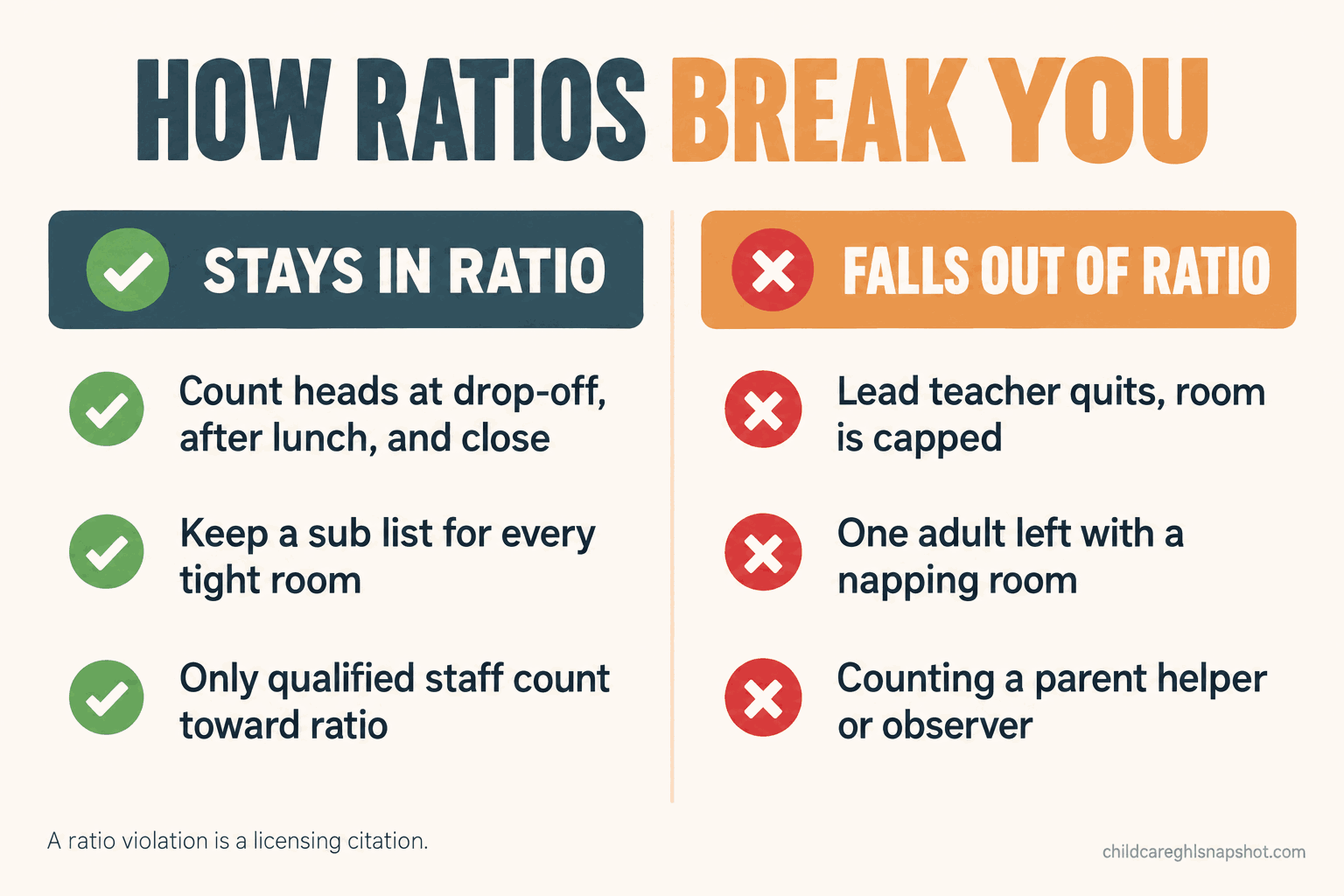
The ratio does not usually bite on a calm, full day. It bites in the gaps.
The teacher who quits mid-week. The day a lead teacher leaves a tight room, you are out of ratio and capped. You cannot enroll the family at the top of your waitlist, so revenue is frozen until you staff back up. This is why teacher retention sits in the same conversation as enrollment. We wrote a whole piece on reducing childcare staff turnover without raising tuition, because every departure is also a capacity cut.
Nap time and the single-adult drift. It is tempting to send a teacher on break after lunch and leave one adult with a sleeping room. If that drops you below ratio, it is still a violation, asleep or awake. Build breaks into the schedule so coverage never dips, and remember that combining ages to save a teacher triggers the mixed-group rule, which in many states means the strictest ratio in the room governs everyone.
The adult who does not count. A parent helping on a field trip, a student observer, a maintenance worker: in most states none count toward ratio, only your qualified, assigned staff. And when a miss becomes a citation, the lasting cost is rarely the fine. It is the enrollment you lose when a family searches your licence number and reads the violation on your public record before they ever call.
Steal this: the ratio board and tour copy
Two things you can use today. First, a one-page ratio board for each room, posted where the teacher can see it.
ROOM RATIO BOARD
Room name: ________ · Age band served: ________ to ________ State ratio for this age: 1 adult to ________ children Group size cap (if your state has one): ________ children Maximum children in this room at ratio: ________ Teachers required to run full: ________
Today: children present ________ · adults on the floor ________ · in ratio? Y / N If “N” at any point: move a child, pull a sub, or combine rooms per the mixed-age rule.
Have the opening teacher fill the bottom line at drop-off, after lunch, and at close. Three thirty-second checks a day catch almost every drift before an inspector does.
Second, and almost no center uses this, turn the ratio into a tour line. Parents touring your center are quietly worried about one thing: will someone actually watch my child. Your ratio is the proof. Here is copy to adapt, spoken on the tour and written on the room door:
“In our infant room we stay at one teacher for every four babies, which is the limit the state sets, and we do not go above it. That is why you will always see at least two teachers in here. In the toddler room it is one to [your number]. We post the count on the door every morning, so you can check it yourself at pickup.”
That is not spin, it is a fact you are already living, said plainly, and it beats every soft phrase about a “nurturing environment” because it is specific and checkable. A parent who hears it believes the rest of your tour. Our enrollment phone script covers the call that books the tour in the first place.
Texting families and child records
The moment you text a family that a spot opened, two rules apply: the TCPA governs consent for automated messages and A2P 10DLC is the carrier registration business texting now requires. Get a clear opt-in and register your number, or your messages quietly stop arriving. We laid out the whole thing in can you legally text daycare parents. And clear up one myth while you are here: FERPA, the school-records law, generally does not apply to a private licensed daycare, so do not let a vendor use it to frighten you into a purchase. Your real obligations come from your state’s rules on child-record confidentiality and photo and video consent. The line to hold: never name or show a specific child in marketing without consent on file.
Objections, answered
“The ratio is a minimum. Do I need to beat it?” No, but understand it is a floor, not a target. Accreditation bodies like NAEYC recommend tighter ratios than most states require, and parents notice. Running one notch better in your infant room can win the tour. Price it as what it is, a feature.
“Can’t I use the opening and closing exception to run leaner?” Only if your state has one, only within the exact window it defines, and almost never for infants. It exists for the genuine trickle at the edges of the day, not as a staffing strategy, and that is exactly when inspectors show up.
“Isn’t tracking ratio my management app’s job?” Your check-in app can show a live count. But it does not staff the room, keep a sub list, or fill the empty seats that make the staffing affordable. The ratio is a people-and-schedule problem first, a software readout second. The software that matters most keeps every allowed seat full, so the teachers the ratio forces you to hire are actually paid for.
Your questions, answered
What is the staff-to-child ratio for a daycare?
There is no single national ratio. Each state sets its own by age. As a rough map, most states require about one adult to four infants, one to about six toddlers, and one to roughly eight to twelve preschoolers, but use your own state's exact number for the exact age of the children in the room.
Which states have the strictest daycare ratios?
New York is among the strictest, at one adult to four infants with a group-size cap of eight. Florida and Texas are more permissive, especially for older children, where Texas allows up to one adult to twenty-six for school-age kids. Always confirm against the current state rule.
Is there a federal daycare staff-to-child ratio?
No. Federal law requires states to set ratios and group sizes, but the numbers are state licensing rules. The one federal reference point is Head Start, which runs infants and toddlers under three at one adult to four, stricter than most state licensing minimums.
What happens if my center is out of ratio during an inspection?
It is a citation: a fine, a corrective-action plan, a probationary status posted on the public licensing record, or in serious or repeat cases suspension of the room or licence. The lasting cost is usually the enrollment you lose when families read the violation on your public record.
How do ratios affect how much a classroom costs to run?
Directly. The ratio sets the number of teachers you pay before you enroll a single child, and labor is 60 to 80 percent of a center's costs. A tight infant ratio means two salaries on a handful of seats, which is why infant rooms are the hardest to run profitably and preschool rooms tend to subsidize them.
So, back to that inspector in the doorway. The centers that never have the 7:40am moment are not the ones with the fanciest software. They are the ones where every teacher knows their room’s number cold, the count gets checked three times a day, and the seats under the cap are filled on purpose so staffing pays for itself. Learn your state’s number, post it, check it, then go fill every seat it allows.